How to budget as a couple: a simple plan for shared money
Joint accounts or separate? Who pays which bill? Here is a calm way to set up shared money in one evening, with a fair split when your incomes are different.
Money is one of the easiest things for two people to disagree about, and most of the time the numbers are not the real problem. The problem is that nobody decided who pays for what, how much each person can spend freely, or what you are both saving for. A shared budget settles those questions once, so they stop coming up at the checkout or at 11 at night.
This plan works whether you are newly living together, engaged, or married for years and never set anything up.
The short version
- Put every number on the table: income, bills, debts and savings.
- Pick an account setup: all joint, all separate, or a mix.
- Decide how to split shared bills, evenly or by income.
- Build one budget from your combined take-home pay.
- Give each person spending money that needs no explaining.
- Agree on a "talk first" amount for bigger purchases.
- Choose one or two goals to save for together.
- Meet for 20 minutes once a month.
1. Start with a money date
Pick a relaxed hour, not the middle of a stressful week. Each of you brings the same four things: take-home pay, regular bills, what you owe (cards, car, student loans) and what you have saved. Write it all on one page.
The goal of this first talk is only to see the full picture. No fixing, no blame. It also helps for each of you to pull your own credit reports first. They are free every week from the three nationwide bureaus at AnnualCreditReport.com, and they list every open account, so nothing gets forgotten.
If you tend to handle money in different ways, one saver and one spender for example, the free money personality quiz is a light way to start the conversation.
2. Pick an account setup
There are three common ways to arrange accounts. None of them is the right one for everybody. Choose the one you will both keep up with.
| Setup | How it works | Good fit when |
|---|---|---|
| All joint | Both paychecks go into shared accounts. Every bill and purchase comes out of them. | You share most costs and goals and want the fewest accounts to track. |
| Yours, mine and ours | One joint account for shared bills and savings, plus a personal account each. You each move a set amount into the joint account every payday. | You want shared bills handled together and some money that is fully your own. |
| All separate | You keep your own accounts and each pay an agreed list of bills, or send your share to whoever pays. | You are early in living together, or one of you has debts or a business to keep apart. |
Two things to know about joint accounts. First, either owner can usually take out any amount, so open one only with someone you trust with the full balance. Second, at an FDIC-insured bank a joint account is insured up to $250,000 per co-owner, on top of what each of you has insured in your own name.
3. Decide how to split shared bills
If you earn about the same, splitting shared bills down the middle is simple and fair. If your incomes are far apart, an even split can leave one person with almost nothing after the bills. In that case, split by income instead.
Here is how the two methods compare for a couple with $3,500 a month in shared bills.
| Partner A | Partner B | |
|---|---|---|
| Monthly take-home pay | $4,200 | $2,800 |
| Share of total income | 60% | 40% |
| Even split of $3,500 | $1,750 | $1,750 |
| Part of own pay used | 42% | 63% |
| Split by income | $2,100 | $1,400 |
| Part of own pay used | 50% | 50% |
To work out your own split, add both take-home amounts, then divide each person's pay by the total. That gives each person's percentage. Multiply the shared bills by each percentage. Redo the math when someone gets a raise, changes jobs or cuts their hours.
If one of you is at home with children or between jobs, the same idea still applies. The household runs on one income for now, and both of you still get a say and your own spending money.
4. Build one shared budget
Now make a single budget from your combined take-home pay. A simple starting point is the 50/30/20 split: about half for needs, 30% for wants and 20% for savings and extra debt payments. For the couple above, with $7,000 coming in, that is roughly $3,500 for needs, $2,100 for wants and $1,400 for savings and debt.
The free budget calculator does this in a few seconds. Enter your combined take-home pay and adjust the split until it matches your real bills. If either of you is paid every two weeks, the paycheck budget calculator lines bills up with paydays. If one income changes from month to month, build the budget on the lower months. Our guide to budgeting on an irregular income shows how.
5. Give each person their own spending money
This is the step that prevents the most arguments. Set an amount each of you can spend every month on anything at all, with no need to explain it. Coffee, games, shoes, lunch with a friend: it is nobody else's business.
The amount comes out of the wants part of the budget. Many couples make it the same for both people, even when one earns more, so you both have the same freedom.
6. Agree on a "talk first" amount
Pick a dollar figure, $100 or $200 for example, and agree that any purchase above it from shared money gets a quick conversation first. It is not asking for permission. It is a heads-up, so neither of you is surprised by a charge and both of you can say "let's wait until next month" when the budget is tight.
7. Choose shared goals
A budget is easier to stick to when you both know what it is for. Pick one or two goals and name them: a starter emergency fund, a trip, a down payment, a paid-off card. Give each one a dollar amount and a date.
The savings goal calculator turns a goal into a monthly amount, and the emergency fund calculator shows how much a cushion for your household should hold. For costs that come around every year, like car insurance, holidays and travel to see family, set up sinking funds so they stop landing as surprises.
8. Hold a 20-minute monthly check-in
Put it on the calendar, same day every month. Keep the agenda short:
- What came in and what went out last month.
- Any category that ran over, and what to change.
- Progress on your shared goals.
- Anything coming up next month: birthdays, renewals, travel, car work.
- One thing that went well.
Take turns running it. When both people can find every account and know when each bill is due, nobody carries the whole load, and either of you could take over if the other were sick or away.
What about debt one of you brought in?
Be open about it in the first money date, with balances and interest rates. Then decide together how it gets paid. Some couples pay it from shared money because clearing it helps both of them. Others have the person who owes it pay from their own account. Either can work if you both agree.
Keep in mind that anything you both signed for, like a joint card or a co-signed loan, is owed by both of you, whatever you agree at home. Rules for debts taken on during a marriage differ from state to state, so ask a local professional if this matters for a big decision. To compare payoff orders, try the debt payoff calculator.
Example: A couple takes home $4,200 and $2,800 a month. They open one joint checking account for rent, utilities, groceries and insurance, and split those $3,500 in bills 60/40. Each keeps a personal account with $250 a month of no-questions spending money. They set a "talk first" amount of $150 and send $400 a month to a joint savings account for a $4,800 emergency fund, which they will reach in 12 months. On the first Sunday of each month they spend 20 minutes going over the numbers.
Build your shared budget in a minute
Enter your combined take-home pay and see a needs, wants and savings split you can both work from. No sign-up.
Open the budget calculator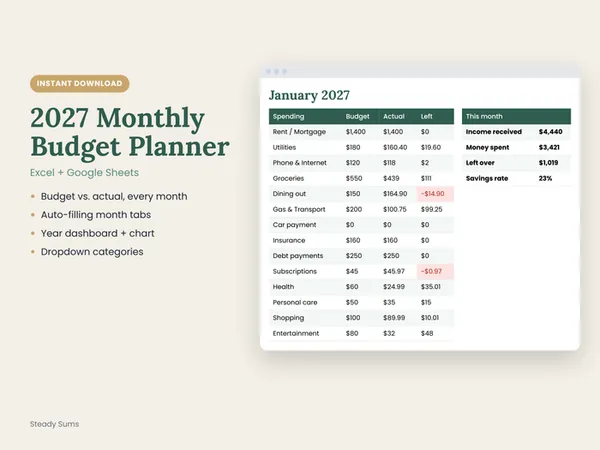
One sheet you can both open.
Set your shared categories once, log what you each spend and watch the totals update. Works in Excel and Google Sheets, so you can share it between two phones.
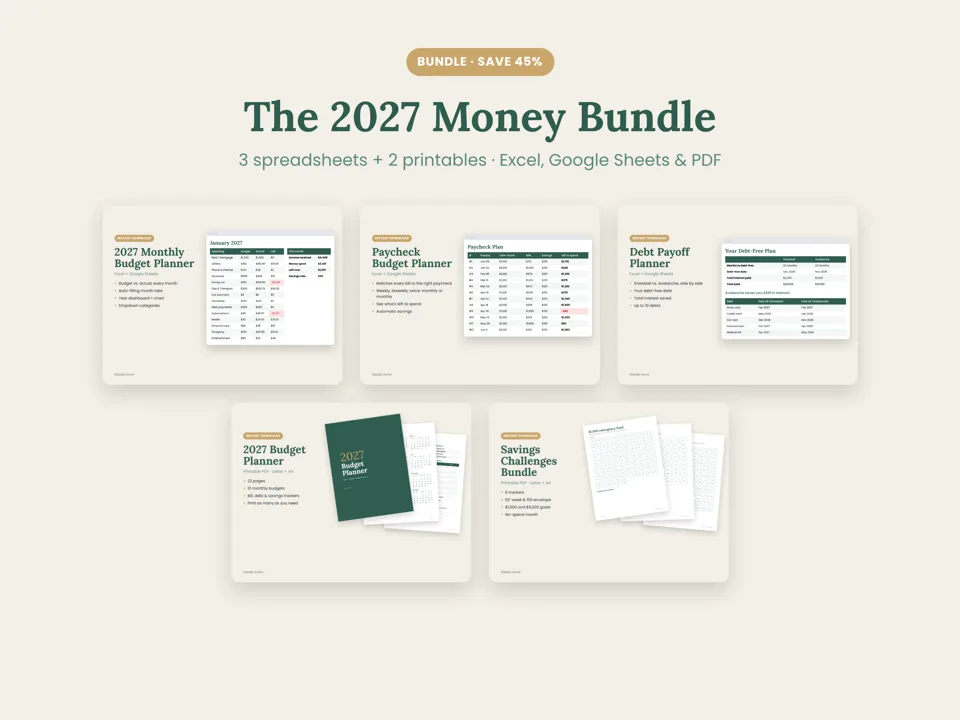
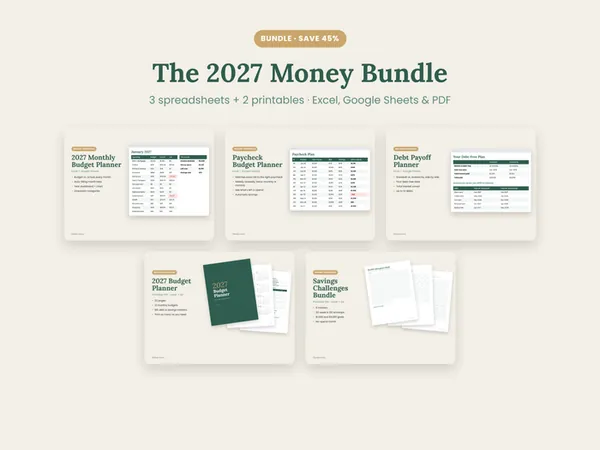
Budget, bills and savings pages together.
The monthly budget spreadsheet plus a bill tracker and printable pages for savings goals. Handy to bring to the monthly check-in.
One plan you can both check.
Budget, debt payoff and shared savings goals in one calm app, on your phone or computer. Free for 14 days, then $5/month or $48/year. No card needed to start.
Try the Planner freeQuestions people ask
Should couples have a joint bank account?
It depends on what keeps things simple and fair for the two of you. Many couples use one joint account for shared bills and goals and keep a personal account each for their own spending. Fully joint and fully separate setups can also work, as long as you both can see the whole picture and agree on the plan.
How do you split bills when one person earns more?
A common way is to split shared bills in proportion to take-home pay. Add both incomes, work out each person's share of the total, and apply that percentage to the shared bills. If one of you brings home 60% of the income, that person pays 60% of the shared costs.
How much spending money should each of us get?
There is no set number. Pick an amount that fits inside the wants part of your budget and that neither of you has to explain. Many couples give each person the same amount, even when incomes differ, so both have the same freedom.
How often should we talk about money?
A short check-in once a month is enough for most couples. Look at what came in, what went out, how the goals are doing and what is coming up next month. Twenty minutes on a set day works better than long talks only when something goes wrong.
Is money in a joint account insured?
At an FDIC-insured bank, joint accounts are insured up to $250,000 per co-owner, so a joint account owned by two people is covered up to $500,000 at that bank. This is separate from the coverage each person has on accounts in their own name.
Sources: FDIC, Deposit Insurance At A Glance; Consumer Financial Protection Bureau, Budgeting: How to create a budget and stick with it; Federal Trade Commission, Free credit reports. The example and the bill-split table are illustrations, not your actual numbers.
Education only, not financial advice. Steady Sums shares general education; for decisions about your situation, talk to a licensed professional or tax preparer.
More money guides
The new year budget reset: 7 steps for a calmer January
January is the easiest month to change your money habits. Here's a simple reset you can finish in one weekend, with an optional no-spend challenge to kick it off.
Read the guide →Sinking funds: the easy way to pay for big expenses
Most budget-busting bills aren't emergencies. They're predictable expenses that show up once or twice a year.
Read the guide →How to read your pay stub (every line, explained)
Gross pay, deductions, Social Security and Medicare, and a sample stub that shows why take-home pay is smaller.
Read the guide →Make it easier with the right tool


One calm money move a week.
A 3-minute Tuesday email with one simple step for budgeting, saving and paying off debt. Join free and get a printable $1,000 emergency fund tracker.
Free. One email a week. Unsubscribe any time.