Year-end money checklist: 10 things to do before December 31
A few December moves can trim your tax bill, keep you from losing money you already set aside and give 2027 a clean start. Most of them take less than 15 minutes.
December fills up fast, and money tasks are the first thing to slip. The trouble is that a few of them have a hard December 31 deadline. Miss it and the chance is gone for the year. Work through this list once, in order, and you are done until spring.
The deadlines at a glance
| Task | Deadline for tax year 2026 |
|---|---|
| Spend health FSA money | Dec 31, unless your plan has a grace period |
| 401(k), 403(b) contributions | Your last paycheck of 2026 |
| Charity gifts for a 2026 deduction | Dec 31 |
| Required minimum distributions (age 73+) | Dec 31 (first one can wait until April 1) |
| IRA contributions | April 15, 2027 |
| HSA contributions | April 15, 2027 |
1. Use up your FSA
A health flexible spending account (FSA) is mostly use-it-or-lose-it. Log in and check the balance now, while there is still time to book a checkup, refill prescriptions, or buy glasses, contacts or first-aid supplies. Your plan may offer a short grace period into next year or let you carry over a small amount, but not both. Read your plan's rules before you count on either.
While you are there, set your 2027 election with this year's real spending in mind. For 2026 the IRS limit for health FSA contributions is $3,400.
2. Check your 401(k) before the last paycheck
For 2026 you can put up to $24,500 into a 401(k), 403(b) or most 457 plans. If you are 50 or older you can add an extra $8,000, and people aged 60 to 63 can add up to $11,250 instead. Contributions only happen through payroll, so the deadline is really your last 2026 paycheck, and payroll usually wants a week or two of notice.
You don't have to max it out. The most useful check is simpler: are you putting in enough to get your employer's full match? If not, that is free money left on the table. Raise your rate for the last paycheck or two if your budget allows.
3. Know your IRA window
An IRA gives you more time. You can add money for 2026 until April 15, 2027. The 2026 limit is $7,500, plus $1,100 if you are 50 or older. If December is tight, put a reminder in your calendar for March and use part of a tax refund.
4. Look at your HSA, too
If you have a high-deductible health plan and a health savings account (HSA), you also have until April 15, 2027 to contribute for 2026. Unlike an FSA, HSA money stays yours and rolls over every year, so there is no rush to spend it. Check the limit for your coverage in IRS Publication 969 before you top it up.
5. Give to charity with a paper trail
New for tax year 2026: if you take the standard deduction, you can still deduct up to $1,000 in cash gifts to qualified charities, or $2,000 if you are married filing jointly. Gifts of clothing or goods, gifts to donor-advised funds and money sent to individuals or personal fundraisers don't count.
Give by card, check or bank transfer so you have a record with the charity's name, date and amount. For any single gift of $250 or more, get a written acknowledgment from the charity. Gifts must be made by December 31 to count for 2026.
6. Check your tax withholding
Ten minutes with the IRS Tax Withholding Estimator can save you a surprise bill in April. Use it if you changed jobs, got a raise, picked up side income or had a big life change this year. If you are self-employed, the fourth estimated tax payment for 2026 is due January 15, 2027.
7. Start your tax folder now
Make one folder, paper or digital, and drop each tax form in as it arrives in January: W-2s, 1099s, mortgage and student loan interest statements, HSA and IRA forms, and your charity receipts. Filing goes much faster when nothing has to be hunted down.
8. Review the year's spending
Pull your statements for the year and add up the big categories: housing, food, transportation, subscriptions, gifts and travel. You are not grading yourself. You are looking for the one or two lines that ran well over what you expected, because those are where next year's money will come from. The money leak finder shows what small repeat costs add up to over a year.
9. Clear out subscriptions and annual renewals
Scroll a year of card statements for anything that renews once a year: memberships, software, storage, warranties. Cancel what you no longer use before it renews, and put the rest on a list with their renewal months so they stop catching you off guard. A sinking fund for annual bills turns those surprises into small monthly amounts.
10. Pull your free credit reports
You can get free credit reports from all three nationwide bureaus every week at AnnualCreditReport.com, the official site. Check for accounts you don't recognize, wrong balances and old debts that should have dropped off. If something is wrong, you can dispute it with the bureau for free. Checking your own report doesn't affect your score.
Example: A single renter spends one Saturday morning on this list. She books an eye exam and buys contacts with the $380 left in her FSA, raises her 401(k) rate by 2 points for the last two paychecks to get the full company match, gives $150 to a local food bank by card, and cancels two yearly subscriptions she no longer uses ($119 in total). Then she sets a calendar reminder for March to add to her IRA from her tax refund.
Set up 2027 while it's fresh
Once the list is done, put next year's plan on paper while this year's numbers are in front of you. Our free budget calculator splits your take-home pay into needs, wants and savings in a few seconds, and the savings goal calculator turns a 2027 goal into a monthly amount. For a step-by-step January plan, read the new year budget reset.
Build your 2027 budget in a minute
Enter your take-home pay and see a needs, wants and savings split you can start January with. No sign-up.
Open the budget calculator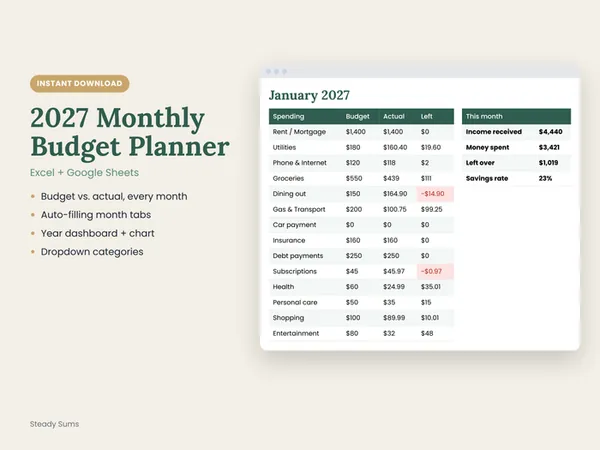
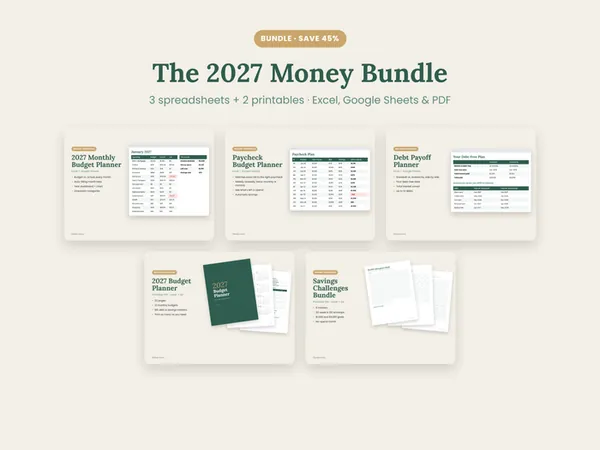
Start 2027 with the whole set.
Monthly budget spreadsheet, bill tracker and printable pages in one download, with space for annual renewals and your 2027 savings goals.
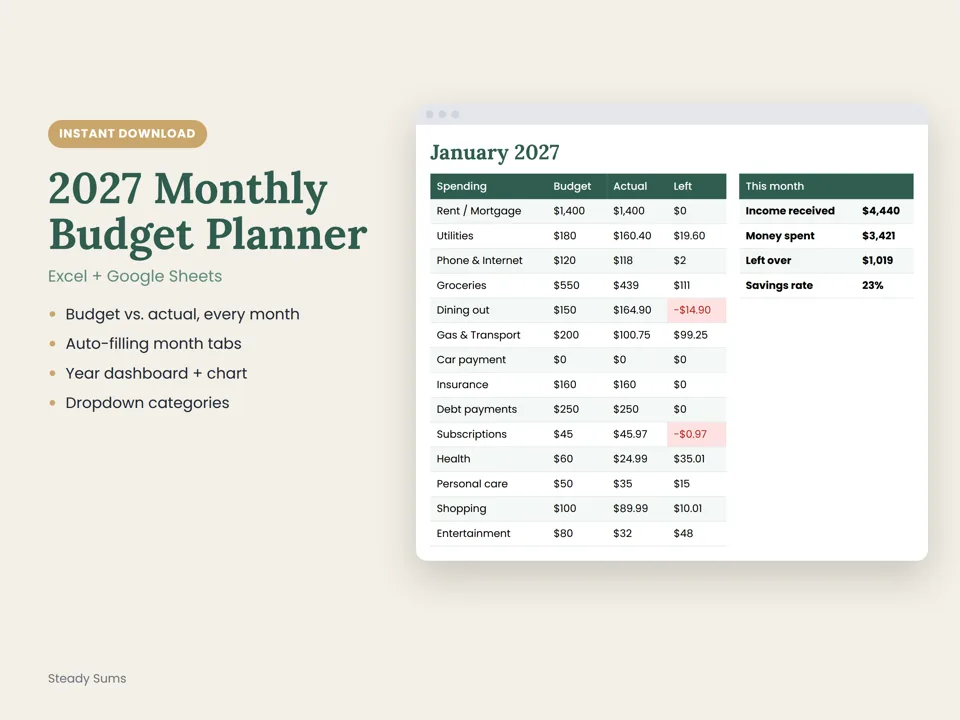
One sheet for every month of 2027.
Set your categories once, log what you spend and watch the totals update. Works in Excel and Google Sheets.
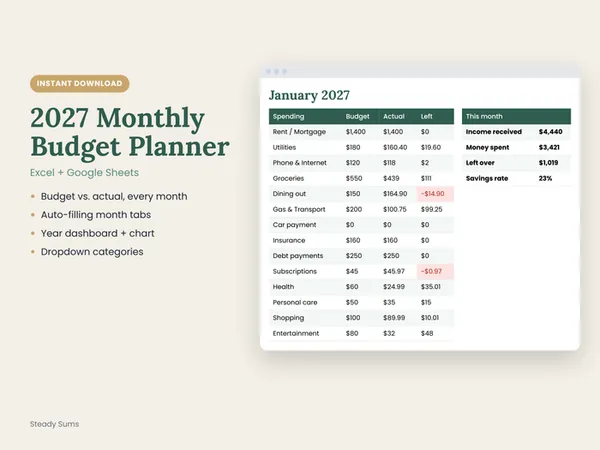
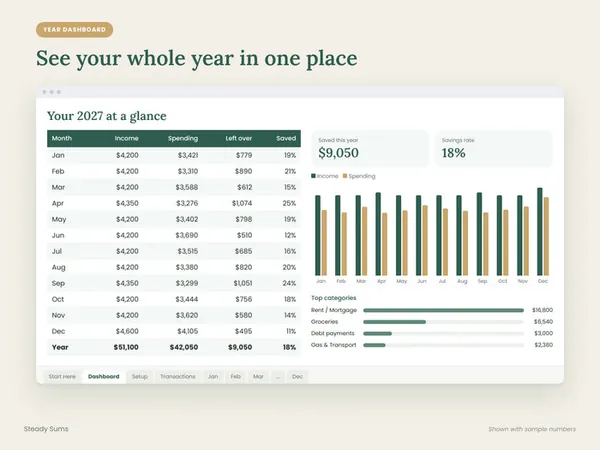
Keep 2027 goals and annual bills in one place.
Budget, debt payoff and savings goals in one calm app, on your phone or computer. Free for 14 days, then $5/month. No card needed to start.
Try the Planner freeQuestions people ask
Can I still put money in an IRA for 2026 after December 31?
Yes. You can make 2026 IRA contributions until the tax filing deadline, April 15, 2027. The 2026 limit is $7,500, plus $1,100 if you are 50 or older. Tell the bank or broker the deposit is for 2026.
When is the last day to add to my 401(k) for 2026?
401(k) money comes out of your paychecks, so the last chance is your final paycheck of 2026. Payroll often needs a week or two of notice, so change your rate in early December.
What happens to FSA money I don't spend?
Unspent health FSA money is usually lost. Some plans give a grace period of up to two and a half months or let you carry a small amount into the next year, but a plan can't offer both. Check your plan's rules.
Can I deduct charity if I take the standard deduction?
Starting with tax year 2026, yes, for cash gifts. People who don't itemize can deduct up to $1,000 ($2,000 for married couples filing jointly) in cash gifts to qualified charities. Gifts to donor-advised funds and to individuals don't count.
How often can I check my credit reports for free?
Every week. AnnualCreditReport.com is the official site for free reports from all three nationwide credit bureaus, and checking your own report doesn't hurt your score.
Sources: IRS, 401(k) limit increases to $24,500 for 2026, IRA limit increases to $7,500; IRS, Retirement topics: catch-up contributions; IRS, Publication 969, Health Savings Accounts and Other Tax-Favored Health Plans; IRS, Publication 15-B (2026); IRS, Topic 506, Charitable contributions; IRS, Required minimum distributions FAQs; IRS, Tax Withholding Estimator; Federal Trade Commission, Free credit reports. Limits shown are for tax year 2026. The example is an illustration, not your actual numbers.
Education only, not financial advice. Steady Sums shares general education; for decisions about your situation, talk to a licensed professional or tax preparer.
More money guides
The new year budget reset: 7 steps for a calmer January
January is the easiest month to change your money habits. Here's a simple reset you can finish in one weekend, with an optional no-spend challenge to kick it off.
Read the guide →Sinking funds: the easy way to pay for big expenses
Most budget-busting bills aren't emergencies. They're predictable expenses that show up once or twice a year.
Read the guide →How to read your pay stub (every line, explained)
Gross pay, deductions, Social Security and Medicare, and a sample stub that shows why take-home pay is smaller.
Read the guide →Make it easier with the right tool


One calm money move a week.
A 3-minute Tuesday email with one simple step for budgeting, saving and paying off debt. Join free and get a printable $1,000 emergency fund tracker.
Free. One email a week. Unsubscribe any time.